Time again to take a peek at the TBR and a few books I’m especially excited about in the next month.
1. Hearing Happiness: Deafness Cures in History by Jaipreet Virdi (May 1)
Through lyrical history and personal memoir, Hearing Happiness raises pivotal questions about deafness in American society and the endless quest for a cure. Taking us from the 1860s up to the present, Virdi combs archives and museums in order to understand the long history of curious cures: hearing trumpets, violet-ray apparatuses, pneumomassages, electrotherapy machines, airplane diving, bloodletting, skull hammering, and many more. Hundreds of procedures and products have promised grand miracles but always failed to deliver—a legacy that is still present in contemporary biomedicine.
2. Resistance: A Songwriter’s Story of Hope, Change, and Courage by Tori Amos (May 5)
Since the release of her first, career-defining solo album Little Earthquakes, Tori Amos has been one of the music industry’s most enduring and ingenious artists. From her unnerving depiction of sexual assault in “Me and a Gun” to her post-9/11 album Scarlet’s Walk to her latest album Native Invader, her work has never shied away from intermingling the personal with the political.
3. Death by Shakespeare: Snakebites, Stabbings and Broken Hearts by Kathryn Harkup (May 5)
Shakespeare found 74 different ways to kill off his characters, and audiences today still enjoy the same reactions–shock, sadness, fear–that they did over 400 years ago when these plays were first performed. But how realistic are these deaths, and did Shakespeare have the science to back them up?
4. Tasting Qualities: The Past and Future of Tea by Sarah Besky (May 12)
What is the role of quality in contemporary capitalism? How is a product as ordinary as a bag of tea judged for its quality? In her innovative study, Sarah Besky addresses these questions by going inside an Indian auction house where experts taste and appraise mass-market black tea, one of the world’s most recognized commodities. Pairing rich historical data with ethnographic research among agronomists, professional tea tasters and traders, and tea plantation workers, Besky shows how the meaning of quality has been subjected to nearly constant experimentation and debate throughout the history of the tea industry.
5. The King of Confidence: A Tale of Utopian Dreamers, Frontier Schemers, True Believers, False Prophets, and the Murder of an American Monarch by Miles Harvey (May 12)
In the summer of 1843, James Strang, a charismatic young lawyer and avowed atheist, vanished from a rural town in New York. Months later he reappeared on the Midwestern frontier and converted to a burgeoning religious movement known as Mormonism. In the wake of the murder of the sect’s leader, Joseph Smith, Strang unveiled a letter purportedly from the prophet naming him successor, and persuaded hundreds of fellow converts to follow him to an island in Lake Michigan, where he declared himself a divine king.
6. Sunny Days: Sesame Street, Mister Rogers, and the Children’s Television Revolution by David Kamp (May 12)
In 1970, on a soundstage on Manhattan’s Upper West Side, a group of men, women, and Muppets of various ages and colors worked doggedly to finish the first season of a children’s TV program that was not yet assured a second season: Sesame Street. They were conducting an experiment to see if television could be used to better prepare disadvantaged preschoolers for kindergarten. What they didn’t know then was that they were starting a cultural revolution that would affect all American kids.
7. We Had No Rules by Corrine Manning (May 12)
A young teenager runs from her family’s conservative home to her sister’s NY apartment to learn a very different set of rules. A woman grieves the loss of a sister, a “gay divorce,” and the pain of unacknowledged abuse with the help of a lone wallaby on a farm in Washington State. A professor of women’s and gender studies revels in academic and sexual power but risks losing custody of the family dog.
8. Entangled Life: How Fungi Make Our Worlds, Change Our Minds & Shape Our Futures by Merlin Sheldrake (May 12)
Fungi throw our concepts of individuality and even intelligence into question. They are metabolic masters, earth makers, and key players in most of life’s processes. They can change our minds, heal our bodies, and even help us remediate environmental disaster. By examining fungi on their own terms, Sheldrake reveals how these extraordinary organisms–and our relationships with them–are changing our understanding of how life works.
9. The Language of Butterflies: How Thieves, Hoarders, Scientists, and Other Obsessives Unlocked the Secrets of the World’s Favorite Insect by Wendy Williams (May 12)
Monarch butterflies migrate thousands of miles each year from Canada to Mexico. Other species have learned how to fool ants into taking care of them. Butterflies’ scales are inspiring researchers to create new life-saving medical technology. Williams takes readers to butterfly habitats across the globe and introduces us to not only various species, but to the scientists who have dedicated their lives to studying them.
10. The Equivalents: The Untold Story of the Five Friends Who Started a Personal, Political, and Artistic Revolution by Maggie Doherty (May 19)
In 1960, at the height of an era that expected women to focus solely on raising families, Radcliffe College announced the founding of an Institute for Independent Study, offering fellowships to women with a Ph.D. or “the equivalent” in artistic success. Acclaimed writer and Harvard lecturer Maggie Doherty introduces us to five brilliant friends–poets Anne Sexton and Maxine Kumin, painter Barbara Swan, sculptor Marianna Pineda, and writer Tillie Olsen–who came together at the Institute and would go on to make history. Drawing from their notebooks, letters, lecture recordings, journals, and finished works, Doherty weaves from these women’s own voices a moving narrative of friendship, ambition, activism, and art.
 He published over a hundred books and illustrated works by Samuel Beckett, T.S. Eliot, Edward Lear, John Updike, Charles Dickens, Hilaire Belloc, Muriel Spark, Bram Stoker, Gilbert & Sullivan, and others. At the same time, he was a deeply complicated and conflicted individual, a man whose art reflected his obsessions with the disquieting and the darkly hilarious.
 Over weeks of training in the opulent but stifling palace, Lei and eight other girls learn the skills and charm that befit being a king’s consort. But Lei isn’t content to watch her fate consume her. Instead, she does the unthinkable–she falls in love. Her forbidden romance becomes enmeshed with an explosive plot that threatens the very foundation of Ikhara, and Lei, still the wide-eyed country girl at heart, must decide just how far she’s willing to go for justice and revenge.
 Nineteen-year-old Nell Hallam lives in a modest corner of Mayfair with her brother Matthew, an inspector at Scotland Yard. An exceptionally talented pianist, she aspires to attend the Royal Academy; but with tuition beyond their means, Nell sets out to earn the money herself—by playing piano in a popular Soho music hall. And the fact that she will have to disguise herself as a man and slip out at night to do it doesn’t deter her.
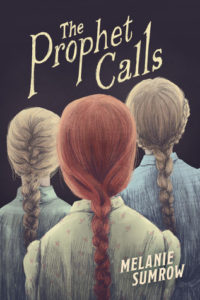 On her thirteenth birthday, Gentry receives a new violin from her father and, more than anything, she wants to play at the Santa Fe Music Festival with her brother, Tanner. But then the Prophet calls from prison and announces he has outlawed music in their community and now forbids women to leave.
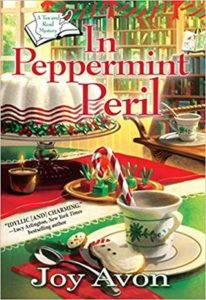 Catering to people who each have their own agenda isn’t easy for the Book Tea crew, especially once the valuable engagement ring goes missing and a dead body turns up in the conservatory. Can Callie and her great aunt use their love of clues to dig into the crimes and show their unhappy hostess and squabbling guests the true Christmas spirit?
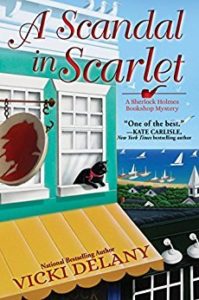 Gemma has no intention of getting involved in the investigation, but when fellow shopkeeper Maureen finds herself the prime suspect she begs Gemma for her help. Ryan knows Gemma’s methods and he isn’t happy when she gets entangled in another mystery. But with so many suspects and so few clues, her deductive prowess will prove invaluable in A Scandal in Scarlet, Vicki Delany’s shrewdly plotted fourth Sherlock Holmes Bookshop mystery.
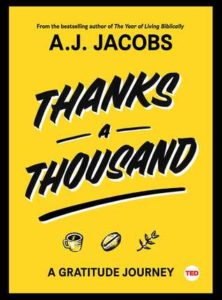 The idea was deceptively simple: New York Times bestselling author A.J. Jacobs decided to thank every single person involved in producing his morning cup of coffee. The resulting journey takes him across the globe, transforms his life, and reveals secrets about how gratitude can make us all happier, more generous, and more connected.
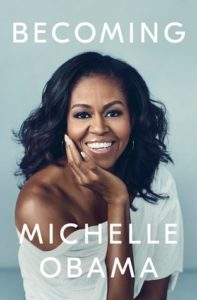 In her memoir, a work of deep reflection and mesmerizing storytelling, Michelle Obama invites readers into her world, chronicling the experiences that have shaped her—from her childhood on the South Side of Chicago to her years as an executive balancing the demands of motherhood and work, to her time spent at the world’s most famous address. With unerring honesty and lively wit, she describes her triumphs and her disappointments, both public and private, telling her full story as she has lived it—in her own words and on her own terms.
 Interweaving fan fiction studies, world-building, and genre studies, Ann McClellan examines the hit series and the fan fiction it inspires. Using Sherlock to trace the changing face of fan fiction studies, McClellan’s book explores how far fans are willing to go to change the Sherlockian canon while still reinforcing its power and status as the source text. What makes Sherlock fanfic Sherlockian? How does it stay within the canon even while engaging in the wildest reimaginings? Sherlock’s World explores the boundaries between canon, genre, character, and reality through the lenses of fan fiction and world-building. This book promises to be a valuable resource for fan studies scholars, those who write fan fiction, and Sherlock fans alike.
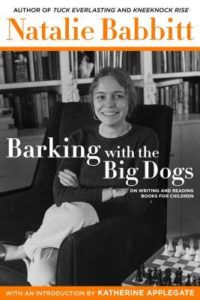 In this collection of essays and speeches written over the course of four decades, beloved storyteller Natalie Babbitt explores what it was like to be a “little dog” in the literary world, continually being forced to justify her choice to write books for children–instead of doing something more serious. Babbitt offers incisive commentary on classic children’s books as well as contemporary works, and reveals colorful insights into her own personal creative life. Filled with a voice that rings with truth, wisdom, and humor across the years, the essays gathered in Barking with the Big Dogs exemplify on every page true reverence for children and an endless engagement with the challenge to write the books that shape them