I picked this one up at the library to put in a holiday display, and I ended up bringing it home to share with Little Miss. At not-quite-four, she’s a bit too young to be very interested in the stories, but she enjoyed the illustrations and the short recounting of the story behind the celebration.
After a few introductory pages about the holiday story and symbols, and a two-page spread on how to play Dreidel, brief vignettes describe family celebrations of Hanukkah in Israel, the United States, Turkey, Uzbekistan, Italy, Australia, Poland, and Tunisia. Each story is accompanied by a note about the Jewish community in that country and a recipe (all of which look delicious), plus full-color painted illustrations. The stories are a little contrived, and explanations of things like why Hanukkah is celebrated in the summer in Australia would have been nice. Personally, I was mystified by the “Hanukkah Wheel”. Is this an East Coast thing? Still, the book is a visually appealing glimpse into Jewish customs around the world. Great for browsing, and likely to spark interest in further reading (and cooking).
Verbena Colter has not been looking forward to the summer after fifth-grade graduation. Over the last year, she has drifted apart from her best friend, become self-conscious about having “the heaviest mother and the oldest father” among her classmates, and learned about a huge family secret. Is it any wonder that she’s been feeling “mixed up and mean”? Now, all she wants is to be anyone other than herself. When she takes an opportunity to do just that, it turns out to be a bit more than she bargained for.
I love the characters Weeks creates in this quiet novel. They feel like real people, with good points and bad, just trying to get along in the world. Verbena is at that age when the world suddenly looks a lot more complicated than it ever has, and her doubts and confusion ring true. She’s figuring out who she is and how to be herself. While she works through her own turmoil, the reader remains pretty sure that things will ultimately work out. Recommend to older elementary students who enjoyed THE HIGHER POWER OF LUCKY.
I’m catching up on a backlog of entries in my Google Reader subscriptions, so it was only today that I read Susan Norwood’s guest blog (from November 21st) at Practically Paradise. “If I had the money,” she begins, “the first thing I would buy for my library is audio books.” Since I review audio books for School Library Journal, and I buy them (as well as other children’s materials) for my own library, this naturally caught my attention.
She goes on to describe how much the kids in her middle school classroom enjoy listening to books read aloud. With Playaways and CDs, students get to choose the books that appeal to them individually. They are connecting with books even when they’re feeling bored and sick of school at the end of the day. Kids are sharing sets of ear buds so that two people can listen to a story they both enjoy at the same time.
This brings us to the major issue Susan faces in using audio books in the classroom. “My biggest problem is availability,” she writes. She has been checking out materials from the local public library on her personal card. She has “invested in rechargeable batteries, a recharger, and some inexpensive headphones.” She has taken note of which books are popular, and which format the kids prefer (Playaways over CDs, for reasons she explains).
But she can only do so much. Audio books are expensive. The people who make the purchasing decisions are unlikely to have had the time and/or opportunity to listen to audio books, and so they must buy based on reviews. Budgets for audio materials are likely to be small (and getting smaller all the time, thanks to budget cuts), yet an audio version of a title can cost twice as much as its (hardcover) print counterpart. Susan mentions the Goosebumps books as favorites of her students. The Playaway version of R.L. Stine’s Goosebumps HorrorLand: Creep from the Deep costs $34.99. The Library Edition CD costs $29.95. The hardcover is $14.85. The mass market paperback retails for $5.99. You do the math. And so, when you take a look at your local library’s audio book selection, you might not find much there.
I don’t believe that it’s just financial concerns that keep the library shelf selection of audio books small. There is a perception out there that reading from the printed page is the only kind of reading that counts. (This is a perennial discussion when it comes time for Summer Reading logs.) Susan writes near the end of her entry, “My next door teacher-neighbor has a quote that goes something like this, ‘Readers are made on the laps of their parents.’ Not all of our kids have parents who read. Not all of our kids have parents who speak, let alone read, English.” For these kids, especially, audio books may be a lifeline to literacy. Anyone who has spent time in a classroom knows how much kids enjoy being read to, even those who have become far too cool in their advanced age (of 10 or 11) to admit it. I’ve seen it in family storytimes, when older siblings and cousins often accompany the little ones. Why wouldn’t you want a kid to be able to take that pleasure home?
In my small role buying materials for one neighborhood public library branch, I’ve been working to build up our audio book collection – from those chapter books on CD down to those picture-book-plus-CD sets. If you have the chance, won’t you help your local public or school library? Playaway books are available for purchase on the Playaway site (though you may want to make sure your particular library is able to circulate them), and books on CD are available pretty much anywhere books are sold. Or just make your voice heard: let the decision-makers in your community know that books are important, and audio books are important, too. Make sure they’re listening.
The official NaNoWriMo Word Counter says I have 50,426 words. I think I might have to buy myself a “winner” t-shirt. And on December 2nd, I am taking advantage of that discount on Scrivener.
Happy Thanksgiving to those who are celebrating today. I’m thankful that I married a good cook, especially since I sliced my thumb open washing a knife last night.
Seriously, I have much for which to be thankful. Now, if you’ll excuse me, Lil Miss and I have a parade to watch.
I haven’t tried doing a reading challenge over here yet, but I just can’t resist The Story Siren. (Heh. See what I did there?) This particular challenge is all about reading debut Middle Grade/Young Adult novels. The idea is to read and review at least 12 titles in 2011. While I read children’s books by many different authors, I can get in a bit of a rut when it comes to YA. I’m looking forward to encountering some fabulous new authors.
I’m a winner! It won’t be official until word count verification opens on the 25th, but still. I did it!
50,059 words. 153 double-spaced, 12-point type pages.
I crossed the 50,000 word mark Saturday night. Last word written? “Weird”.
13 days. That’s just crazy.
I spent some time yesterday on revising, but I think I need to take a little time away from it first. Writer-folks, is it normal to look at your draft and despair of it actually becoming something worth reading? Or is it just me?
Yep, I think I’ll let it rest for a bit. I have some knitting to do.
In late 2002, I was fresh out of Library School and still a new arrival to L.A. I only knew a few people, and none of them very well. I didn’t know the city at all. I had very little money. I had a tiny, tiny apartment and a PC that was on its last legs, although I didn’t know that quite yet. On that little old PC, I had started writing again, after taking a break following my graduation with a B.A. in Creative Writing.
On November 1st, I started writing a novel. I didn’t have a great idea. I didn’t have an outline. I had a couple of characters and a concept that had had two false starts already. So why did I start writing? That day, I read an entry on Neil Gaiman’s blog that pointed me toward NaNoWriMo.
I love the whole concept of NaNoWriMo. I know how easy it is to let those story ideas fade away without writing anything down. It’s even easier to write down the idea and abandon it when the writing gets hard. And it’s much, much easier to stop writing than to force your way past that Internal Editor that tells you that if your story isn’t perfect right away, then it isn’t worth writing.
NaNoWriMo gives the wanna-be writer a ridiculous goal: 5o,000 words in 30 days. If you want to finish, you have to keep writing. When the story stalls, you have to keep writing. When the story takes bizarre turns you never planned, you have to keep writing. When the story starts to look like just a bunch of clumsy words, you have to keep writing. There is no time to go back and edit. There is no time to polish up that prose. There is no time to lose momentum in research.
If you want to “win” NaNoWriMo, you just have to write.
I “won” that first year, writing 51,008 words. There was a beginning, a middle, and end. There was also a huge digression into what should have been an entirely different novel, and there was a character I referred to as a “brother ex machina” when he appeared halfway through.
Somewhere, I have a print-out of that story, that novel, and that is the only copy, since that particular computer crashed and went to Digital Heaven six weeks later.
I took on the NaNoWriMo challenge again in 2003 and 2004, but both attempts remain unfinished. The 2004 novel stopped at 32, 143 words. The 2003 novel met a sad fate. It exists as several “untranslatable” files.
And that was that. Until this year, when I got an itch to start writing again. When I saw a mention somewhere about the authors who would be doing the pep talks this year, I signed up just to get those in my inbox. And, of course, I couldn’t just leave it at that. So, on November 1st, I started a new novel. You can see my word count in the sidebar. As of this moment, I am at 42,012 words. Apparently, if I don’t write much fiction for a few years, it all comes pouring out at once.
It’s a messy first draft. I’ve shifted character’s traits and altered the timeline in ways I will need to go back and fix. I have things that need to be researched to round out my best guesses. But it’s a draft. There is an actual story there, on the page, instead of just floating around in my head. And, more importantly, I’m writing every day. For me, that’s the point: to get back into the habit of sitting down at the keyboard and putting words on the page (screen, whatever).
After November, I can revise. I can edit. I can turn this messy draft into a real story. I can work on the art and craft of writing something worth reading.
No, I did not trip, fall, or otherwise injure myself
Also, I apologize for the photo quality, and for the fact that I’m using swiped proofs
One of the nice things about having the race start pretty close to home was that I didn’t need to get up at a ridiculous hour to get ready. I was able to get up pretty close to my usual time (which I have been told might be considered a slightly ridiculous hour anyway), have some peanut butter pretzels, get dressed, and head out the door.
K drove me to the drop-off point, and from there it was a pleasant enough walk to the corrals. I was in corral 16. Everyone was in a good mood, which is always nice. I saw a few other shirts from One More Mile, and got some compliments on mine.
We crossed the starting line nearly 30 minutes after the gun, and ran a few miles through Griffith Park.
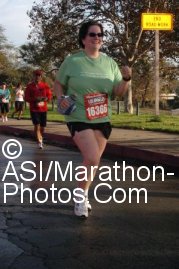
Smiling in the Early Miles
I went out a little faster than I intended, running the first three miles in 11:25, 11:3, and 11:18. That was with planned walking breaks, so I know that when I was running, I was running a little faster than I should have been. And then the hills came, and the walking breaks started getting longer, and I stopped caring about smiling for the cameras.
Walking
It really was a nice course, though, despite the hills. The water stop volunteers were smiling, and I heard a lot of people thanking them as we went through. The bands were entertaining. There were a bunch of different spirit groups, including one that I think was made up of the cheerleaders from Temple City, but I’m still not sure. And, once we left the park, there were lots of people gathered along the streets, cheering us on. I saw a lot of great signs; I think my favorite was the one that said, “That’s not sweat, it’s your fat cells crying.” The most memorable, to me, was one that said, “Run, B****, Run” – without the asterisks. I really, really, REALLY hope that someone asked him specifically for that sign. And also that he figures out for the next time that maybe the rest of us won’t find it quite so amusing. Somewhere in mile 10 – I think, and it was my slowest mile (14:54) – there was a man holding a sign that said, “You’re doing great! Big hill ahead!” I hoped he was joking, but then I turned the corner, and there it was, just as he said, a big hill for our tired legs to slog up.
In mile 11, I think, there was a little girl sitting on the curb with her mother, a cooler full of water bottles in between them. I took one gratefully. It had been a while since the last water stop, and my Nathan handheld bottle was empty. So, thanks, whoever you were!
Once we reached downtown L.A., I started counting down the streets. I knew the finish line was near 11th, and we entered on 3rd (I’ve driven into the city that way many, many times over the last eight years on my way to the Central Library, so this amused me a lot). Of course, a few blocks from the end, we had to turn and do a little zigging and zagging to finish out the last mile. My Garmin, which had been counting down from 13.1 as a “quick workout” decided about a quarter mile from the finish line that I had reached the goal, and stopped recording. Oops. I perked up a lot once the end was in sight, and ran across the line with a smile for the camera.
Crossing the Finish Line
A race volunteer hung the medal around my neck (backwards). After slurping down a bottle of Cytomax (in retrospect, not the best idea, I should stick with water next time), I went for the posed medal shot.
The Official Finisher Picture
In the secure area, there were lots of munchies (mmm, bagels) and cold, cold water. I never made it to the various booths at the Festival. I called K to let her know I was done and that I would be inside ESPNZone, because the insanely loud amps at the Finish Line Festival were too much for me. When she arrived to pick me up, Little Miss ran up to me, saying, “Congratulations!” And, really, that was even better than the medal.
Finally, the official results:
Time: 2:52:27 – a new Half-Marathon PR by 41 minutes
Overall: 7575
Among Women: 4196
In Age Division: 870
And I beat my co-worker’s time by about 4 minutes, although I never saw him, because he started a few corrals ahead of me. Isn’t chip timing fun?
For years, I’ve been fascinated by the Boston Marathon. A few facts for the uninitiated:
1. Boston is the oldest continually run marathon in the United States. The 2011 race will be the 115th running.
2. In 1970, the Boston Athletic Association began imposing qualifying time requirements for entrants in order to limit the field.
3. Boston is the only U.S. marathon (excluding Olympic and other championship races) that requires entrants to meet a qualifying time in a previous race.
4. Boston does provide spaces for runners who do not meet the qualifying standard but are running to benefit charities.
5. Qualifying for Boston (the much-sought “BQ”) is a goal for many, many, many runners.
I would love to run Boston one day. Like many runners, I want to qualify for it rather than take a charity slot. It’s a lofty goal for a slow runner like me, but a girl can dream.
For the runners who have trained and qualified this year, though, one more hurdle (if you’ll pardon bringing the track metaphor into road racing for a moment) came between them and Boston: it sold out.
Registration opened online for qualified racers at 9:00 AM EDT on October 18th. Eight hours and three minutes later, all 21,000 entries had been sold.
The popularity of the race certainly can’t be denied. Nor can the fact that the streets of Hopkinton (where the race begins) can only hold a finite number of runners. And, of course, technicaldifficulties with the registration didn’t help matters. (Those of you who have attempted to buy Wollmeise can empathize, I’m sure.)
There’s been quite a bit of mumbling in the last few years about tightening the qualifying standards. Last week, the Wall Street Journal turned the focus specifically on lowering the qualifying times for women, arguing that (1) women are fueling the current running boom, and (2) the finishing time gaps between elite men and women do not support the current gap in the BQ times.
Since I’m a long way from qualifying for Boston, I’m coming at this strictly as an observer. I’m wondering what folks who’ve run it or hope to run it, and especially those who are close to qualifying but not quite there, think about the possibility of tightening the standards.
Personally, I figure that by the time I’m about 70, my running speed and the BQ times might finally match up.
 Hanukkah Around the World by Tami Lehman-Wilzig