The Grownup by Gillian Flynn

The Grownup

The Grownup by Gillian Flynn

My rating: 5 of 5 stars

I didn’t stop giving hand jobs because I wasn’t good at it. I stopped giving hand jobs because I was the best at it.

That’s our introduction to our unnamed narrator, who has recently started posing as a fortune-teller who reads auras (in the front room of the same establishment where she has been providing orgasms to lonely men in the back room). She’s a clever young woman who grew up a grifter and relies on her keen observation skills to provide just the right story to the right person to part them from their money. But her skills at reading people might not be quite enough in this creepy, twisty tale.

This is a skinny little book at just 62 pages, a hardback the size of a thin paperback. It was originally published as a short story in George R. R. Martin’s Rogues anthology under the title “What Do You Do?” (Which is a really excellent title for this story, actually.) It won the 2015 Best Short Story Edgar.

The narrator (I really wish she had a name) is a compelling character. She’s so sure of herself – a confidence woman in multiple senses. I was reminded a bit of Selina Dawes in Sarah Waters’ Affinity, brought up into the 21st century. She’s flawed in ways she recognizes and in ways she doesn’t. She should be one of those “unlikeable” characters, but you want to like her.

I haven’t read Gone Girl, even though it seems like everyone else has. I really enjoyed this little taste of her writing, so I can see why everyone’s been buzzing about her novels.

Source: Book of the Month club

Reading Challenges: Counts for Read Harder (Task 15: A one-sitting book), Mount TBR

View all my reviews

Sounder by William H. Armstrong

Sounder

Sounder by William H. Armstrong
My rating: 4 of 5 stars

The tall man stood at the edge of the porch. The roof sagged from the two rough posts which held it, almost closing the gap between his head and the rafters.

Somewhere in the deep South, a young black boy lives with his family in a small cabin. One morning, he is surprised to discover pork sausage and ham cooking. For a family of impoverished sharecroppers, this is an unexpected luxury. Even their hound/bulldog mix, Sounder, gets a treat. The joy is short-lived, however, as the white Sheriff and his deputies arrive at their door and take the boy’s father away in chains. The boy grows into a young man with Sounder by his side.

I’ll start by noting the elephant in the room: this book, published in 1969 (and winner of the 1970 Newbery Medal), is a story about a black family written by a white man. The book opens with an author’s note beginning, “Fifty years ago, I learned to read at a round table in the center of a large, sweet-smelling, steam-softened kitchen. My teacher was a gray-haired black man who taught the one-room Negro school several miles away from where we lived in the Green Hill district of the county.” This would have been in the late 1910s; Armstrong was born in Virginia in 1911. He goes on to explain that his teacher told him many stories, including “the story of Sounder, a coon dog.” This book is, says Armstrong, “the black man’s story, not mine.”

Perhaps that is why none of the characters, other than the dog, are given names. For that matter, the place is never specified. Or maybe the vagueness is intended to leave as much as possible to the reader’s imagination.  In any case, our protagonist is always referred to as simply “the boy” – which feels a little awkward and uncomfortable. The particular racist use of the term is touched on in the novel itself: “‘Stick out your hands, boy,’ ordered the second man. The boy started to raise his hands, but the man was already reaching over the stove, snapping handcuffs on the outstretched wrists of his father.”

Throughout the short novel, we see the institutional and casual racism of the place and time through the boy’s eyes. He’s led a fairly sheltered life, rarely leaving the warm circle of his own family. His interactions with the people he encounters over the years reflect the prevailing attitudes.

I think this would be a great book to read with a group (a classroom or a book group) paired with an Own Voices book like Linda Williams Jackson’s Midnight without a Moon or Sharon M. Draper’s Stella by Starlight.

Source: Checked out from the public library

Reading Challenges: Counts for the Old School Kidlit Challenge (published 1969), the Newbery Reading Challenge (Medal Winner: 3 points), and Read Harder (Task 11: A children’s classic published before 1980).

View all my reviews

A Disappointing Start

It’s been a bit of a rough start to my reading year here in 2018. I had high hopes for the first book I read this year, but it was not quite what I expected. I knew going into the second book that I hadn’t loved the book to which it was a sequel. And the book was okay, but that’s it.

Both books count for the Mount TBR challenge, and one counts for the TBR Pile challenge. Neither one satisfies a Read Harder task, so I ought to get cracking on that. I really need something good, too. (I am also reading A Study in Scarlet as part of my personal Canon Reading project, but that’s a known quantity.)

How is your reading year going? Are you working on any challenges? Did you choose a book specifically to be your first book of 2018?

Geek Girls Unite by Leslie Simon

Geek Girls Unite: How Fangirls, Bookworms, Indie Chicks, and Other Misfits Are Taking Over the WorldGeek Girls Unite: How Fangirls, Bookworms, Indie Chicks, and Other Misfits Are Taking Over the World by Leslie Simon
My rating: 1 of 5 stars

Once upon a time, to be labeled a “geek” was a fate worse than death. It meant you were an outcast. A loser. Destined for a solitary existence where a twelve-sided die would provide you with the only action you’d ever know. However, over the past decade or so, four-eyed social pariahs have been waging a quiet — yet powerful — revolt.

Over the course of this relatively-slim volume, Simon describes the “Fangirl Geek”, “Literary Geek”, “Film Geek”, “Music Geek”, “Funny-Girl Geek”, “Domestic Goddess Geek”, and a handful of others lumped into “Miscellaneous Geek”. For each type that gets a whole chapter, there is a quiz for the reader to test her own category knowledge, a “character sketch” of personality traits, a “Geek Mythology” section recounting relevant historical events and people, a “Geek Goddesses” section of short biographies of celebrities who fit the particular type, a list of “Frenemies” to beware of, and a “Geek Love” section describing the type of guy who would be a perfect match for the girl who identifies herself as a Fangirl/Literary/Film/etc Geek.

It’s a fun idea, and the Mythology and Goddesses portions are the best part of the book. Unfortunately, they’re weighed down by the snarky jabs in both the “Frenemies” lists and the quiz sections, and occasionally in the opening “character sketch”. But it was the “Geek Love” bit in each chapter that really left me mystified. It just seemed completely unnecessary. If the overarching theme of the book is “Hey, Geeky Girl, find yourself in this book and take pride in your quirks!”, then what is the relevance of several pages on What Kind of Guy You Should be Looking For? The idea that the reader might not be looking for a guy at all is never even suggested. Apparently, all girl geeks are heterosexual.

I had such high hopes for this book, which just makes it doubly disappointing. I made it my first read of the new year, thinking that it would help set a tone of empowerment and pride. I finished it mostly because I didn’t want to DNF the very first book I was reading for the TBR Pile Challenge.

Source: This book has been sitting on my shelves for years. I’m honestly not sure if I bought it, was given it as a gift, or picked it up at a conference as a freebie.

View all my reviews

2018 Discussion Challenge

Welcome to the 2018 Book Blog Discussion Challenge hosted by Nicole @ Feed Your Fiction Addiction and Shannon @ It Starts at Midnight!

Even when I’ve failed to complete specific reading challenge lists, I’ve still read a lot of books. What I haven’t done is post about them! This challenge is all about starting discussions on book blogs.

There are five levels for this challenge:

  • 1-10 – Discussion Dabbler
  • 11-20 – Creative Conversationalist
  • 21-30 – Chatty Kathy
  • 31-40 – Terrifically Talkative
  • 41+ – Gift of the Gab

I’m aiming for “Creative Conversationalist” with a personal goal of 12 posts, because one post each month sounds reasonable.

Share-a-Tea 2018

Like I could resist this one.

This is a pretty laid-back “challenge”, as it’s all about slowing down and enjoying a book along with a cup of tea. And discussing said books and tea with like-minded folks. You may have noticed that I like tea. A lot.

Becky says, “If you write a post on your blog announcing the challenge (and making a place to keep track of what you’ve read), consider sharing a bit about yourself–your reading and drinking habits.”

So, hi! I’m Beth, a Librarian at a busy branch library in the San Fernando Valley. I’m a transplant from Chicago, but I’ve been here 15 years. I’ve been told that my accent has even changed. (Of course, I can’t hear it!) I’m obsessed with Sherlock Holmes and Dr. John Watson, knitting/crochet/spinning, and tea.

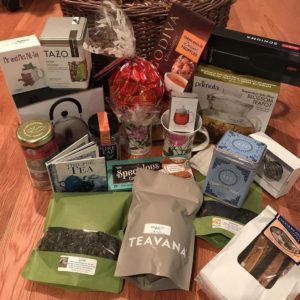
I drink a lot of black tea blends from Adagio. I also get a monthly subscription box from Tea Runners. I like lapsang souchong more than is probably reasonable. I also have a completely ridiculous sweet tooth. I recently won a tea-themed gift basket at a work function, in which there were 13 kinds of tea. (The basket was donated by my area of the library system. Three of those teas were donated by me.)

I’ll admit I was a tiny bit disappointed that that was not actually one giant Lindor truffle.

Mount TBR Reading Challenge 2018

How many books do I have on my shelves that I’ve not got ’round to reading just yet?

Um… well… a few. Some. More than I would like. Enter the Mount TBR Reading Challenge!

Like the Official 2018 TBR Pile Challenge, this is all about reading those books that have been lying around waiting to be read. Those books that were enticing enough to buy, or perhaps were gifts, or (and this covers quite a few of mine) were part of a book-of-the-month type club many months ago.

This challenge is a little bit looser than the other TBR Challenge. Any book you own before 1/1/18 is fair game, and you can pick and choose throughout the year. There are several levels you can choose. I’m aiming for Mount Blanc: 24 books. Half of those will come from the other challenge, naturally. I may end up shooting for a higher goal by December. A girl can dream.

Old School Kidlit Reading Challenge 2018

The Old School Kidlit Reading Challenge is another challenge that relates to my professional reading interests. In addition to keeping up with the latest trends in children’s literature, it’s good to go back and check out some classic books. The rules are pretty simple: set a goal number of children’s books published in the decade of your birth or earlier. I decided on 12 books as my goal, with this tentative list in mind:

  • Sounder by William H. Armstrong
  • My Brother Sam is Dead by James Lincoln Collier & Christopher Collier
  • Ginger Pye by Eleanor Estes
  • The Slave Dancer by Paula Fox
  • My Father’s Dragon by Ruth S. Gannett
  • Julie of the Wolves by Jean Craighead George
  • M. C. Higgins, the Great by Virginia Hamilton
  • To Be a Slave by Julius Lester
  • It’s Like This, Cat by Emily Neville
  • The Twenty-One Balloons by William Pène du Bois
  • Roller Skates by Ruth Sawyer
  • The Egypt Game by Zilpha Keatley Snyder

They’re all Newbery winners or honor books, because I’m doubling-up for these with the Newbery Reading Challenge.

The Official 2018 TBR Pile Challenge


The Official 2018 TBR Pile Challenge is one of two challenges I’m going to work on that focus specifically on books owned but unread. (The other is Mount TBR, which I will post about tomorrow.) I have some books on my shelves that I totally meant to read, but never got around to. Book People know what I’m talking about here.

This challenge has stricter rules than most of the ones I’m attempting. There are no levels. There is no setting your own goal. There is one simple goal: read 12 books from your TBR pile within the year. Only books from 2016 and earlier are allowed; books published in 2017 and still unread do not qualify. The list of 12 – plus two alternates, in case a couple of the 12 turn out to be un-finishable – must be specified by January 15th, 2018.

My List:

  1. The Time of Our Singing by Richard Powers
  2. Geek Girls Unite: How Fangirls, Bookworms, Indie Chicks, and Other Misfits Are Taking Over the World by Leslie Simon – Reviewed: January 3
  3. Mastermind: How to Think Like Sherlock Holmes by Maria Konnikova
  4. The Daylight Gate by Jeanette Winterson – Reviewed: October 17
  5. The Wand in the Word: Conversations with Writers of Fantasy edited by Leonard S. Marcus
  6. Making a Literary Life: Advice for Writers and Other Dreamers by Carolyn See
  7. The American Way of Eating: Undercover at Walmart, Applebee’s, Farm Fields and the Dinner Table by Tracie McMillan
  8. A Study In Lavender: Queering Sherlock Holmes edited by Joseph R.G. DeMarco – Reviewed: April 12
  9. Listening for Madeleine: A Portrait of Madeleine L’Engle in Many Voices Leonard S. Marcus
  10. Sherlock Holmes of Baker Street by William S. Baring-Gould
  11. Weight: The Myth of Atlas and Heracles by Jeanette Winterson
  12. Shadows Over Baker Street edited by Michael Reaves and John Pelan

And the two alternates:

Newbery Reading Challenge 2018

The Newbery Reading Challenge fits nicely into my professional interests as a Children’s Librarian. It’s a points-based challenge:

  • 3 points for a Newbery Medal Winner
  • 2 points for a Newbery Honor Book
  • 1 point for a Caldecott Book

You choose which level to aim for:

  • L’Engle: 15 – 29 points
  • Spinelli: 30 – 44 points
  • Avi: 45 – 59 points
  • Lowry: 60 – 74 points
  • Konigsburg: 75+ points

I’m in for the Konigsburg level. I’m planning to double-up a number of books for this one with the Old School Kidlit Reading Challenge and looking at these possible titles:

  1. Sounder by William H. Armstrong
  2. My Brother Sam is Dead by James Lincoln Collier & Christopher Collier
  3. Ginger Pye by Eleanor Estes
  4. The Slave Dancer by Paula Fox
  5. My Father’s Dragon by Ruth S. Gannett
  6. Julie of the Wolves by Jean Craighead George
  7. M. C. Higgins, the Great by Virginia Hamilton
  8. To Be a Slave by Julius Lester
  9. It’s Like This, Cat by Emily Neville
  10. The Twenty-One Balloons by William Pène du Bois
  11. Roller Skates by Ruth Sawyer
  12. The Egypt Game by Zilpha Keatley Snyder

Every year, too, after the ALA Youth Media Awards are announced (February 12th, 8am MT this year), I go back and read the books I didn’t get to yet. And Caldecott books are often a part of my weekly Storytimes.