Book Review: The Night Fairy

The Night FairyThe Night Fairy by Laura Amy Schlitz
My rating: 4 of 5 stars

When Flory, a tiny Night Fairy no bigger than an acorn, is nearly eaten by a confused brown bat, she finds herself wingless and trapped in a garden. Spunky and determined, she makes a home in an empty birdhouse and tries to live as a Day Fairy. Her challenges and adventures are related in simple, flowing language matching the timeless fairy-tale feel of the story. The watercolor illustrations bring the scenes to vivid life.

Schlitz tells a lovely story with lessons about resiliency, friendship, and growing up without ever preaching to the reader. This slim chapter book would be a wonderful, slightly more sophisticated choice for fans of the many fairy books currently available.

View all my reviews

Picture Book Picks: Knitter Appreciation

What knitter hasn’t had the sad experience of working for hours on a gift item, only to discover that the recipient doesn’t like it, never wears it, or hid or gave it away? I like to call it UGGS: Unappreciated Gift Giver Syndrome, and I still avoid it by mostly knitting just for me. But UGGS also rears its ugly head in fiction, so here are three picture books about knitters looking for a little appreciation. As an added bonus, they all happen to be animals.
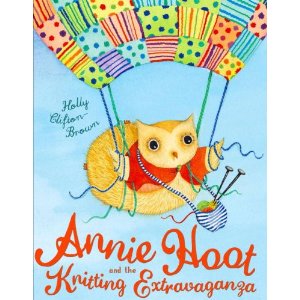
Annie Hoot and the Knitting Extravaganza by Holly Clifton-Brown.

Published in the UK and Australia before hitting the States, this book stars a sweet if slightly dim owl who loves to knit. Unfortunately, her strigine friends refuse to wear the brightly colored clothes she creates. So, she travels around the world (in various partially-knitted forms of transport) in search of some happy knitwear recipients. She tries the rain forest, the African plains, and the Arctic before getting a bit homesick (and running out of yarn). When she gets back home, she discovers that the other owls have come to appreciate her and her gifts. The storytelling is a little clunky, but the watercolor illustrations are adorable, even if it does look like Annie is knitting with two very large iron nails in a rather peculiar style. (It’s probably very hard to knit with wings.) I take issue with the depiction of penguins frolicking with polar bears up in the Arctic – it’s a pet peeve of mine – but they’re so darn cute!
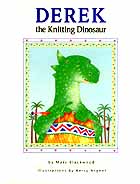
Derek the Knitting Dinosaur, by Mary Blackwood, illustrated by Kerry Argent

In this rhymed-text import from Australia, Derek is a little green dinosaur with a problem. His brothers, Fang and Fearless,  are big, fierce, scary dinosaurs who roar and stomp and fight while Derek just likes to sit inside, knitting and chatting with his friend Montmorency (a cute but quite toothy spotted mouse). Fang and Fearless aren’t all that bothered by Derek’s homebody ways, but he seems to worry that he should be more like them. When the weather suddenly turns colder, Derek’s brothers come to him for the one thing they can’t scare up: some warm clothes. The book closes with Fang and Montmorency agreeing what a good thing it is that “dear little Derek / would rather just sit, / and go / knittety / knittety / knittety / knit!” And Derek himself seems to be pleased enough to have finally found his place. Blackwood conveys an important message about appreciation of differences without being didactic, and Argent’s illustrations are charming. They also add some additional humor; there’s just something about the knitted underpants that makes me giggle.

Knitty Kitty, by David Elliott, illustrated by Christopher Denise.

“Clickety-click. / Tickety-tick.” A grandmotherly cat, complete with half-glasses perched on her nose and a cozy red shawl, sits in an armchair by the fire, knitting up a hat, a scarf, and mittens for three little kittens to wear while playing outside. They’re warm and cozy during the day, but having dressed their snowman in the knitwear, they find themselves chilly and uncomfortable in their sleeping basket at bedtime. Knitty Kitty, of course, has a solution; she curls up along with them in the basket. Denise’s acrylic and ink-on-paper illustrations depict a quaint little country cottage. While Knitty Kitty herself is very human-like, the kittens definitely act like kittens. They pounce on tails, wrestle with the mittens, and poke curiously at a stray ball of yarn. It’s easy to feel the energy of the three little kittens contrasted with the cozy room. A lovely twist on the Three Little Kittens nursery rhyme, this would be a good choice for a bedtime story.

Book Review: Penny Dreadful

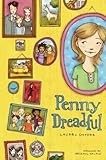
Penny DreadfulPenny Dreadful by Laurel Snyder

My rating: 5 of 5 stars

Penelope Grey has a perfectly fine life. She lives in a big mansion in the City, where all the household chores are taken care off by pleasant staff. She doesn’t even have to go to school, as a tutor comes to her. Her parents – on the rare occasions that she sees them – are nice. She has a couple of nice playmates. Everything is nice. Nice… and really, really boring. She escapes into book after book (the shout-outs to familiar titles are a nice touch), finally deciding to do something that the characters do in each story. That’s how she comes to drop a wish into a well: “I wish something interesting would happen when I least expect it, just like in a book.”

And then, to her surprise, something interesting happens. Her father quits his job, the family runs out of money, and the unexpected inheritance of an old house in a tiny East Tennessee town seems like a lucky solution. But Penelope is about to learn that good things and bad things tend to come wrapped up together, and sometimes luck is a matter of perspective.

The first section of the book is pretty quiet, underscoring Penelope’s serious ennui. When the family leaves the City for Thrush Junction and its colorful inhabitants, the pace picks up. Penelope drops her boring first name for the more cheerful nickname of Penny, and she gets to know the local kids. She starts experiencing adventures instead of just reading about them.

This book got a little bump of publicity when a reader objected to the fact that Penny’s new neighbors include a pair of lesbian moms and their son, a family presented just as matter-of-factly as any of the other characters. For Penny, the fact that Willa has a wife is no more surprising than the fact that she has “hair to her knees.” Like any kid, she’s not all that interested in the relationships between the adults around her.

This is an illustrated chapter book, and Abigail Halpin’s slightly cartoony style offers the perfect complement to Snyder’s text. Throughout the book, the voice of the narrator is excellent. In the first chapter, when Penelope is living vicariously through reading, the narration sounds very much like listening to someone telling the story. As she makes friends and has real-life experiences, the voice of the narrator fades into the background. (With the right voice talent, this could be an OUTSTANDING audiobook.) Filled with gentle humor, quirky characters, and small adventures, this is a good choice for older elementary school readers, especially those who have read and enjoyed some of Penny’s favorite books.

View all my reviews

Book Review: Little Knitted Creatures

Yes, another book review. But it’s a knitting book, and a fantastic one at that!

Little Knitted CreaturesLittle Knitted Creatures by Amy Gaines

My rating: 5 of 5 stars

When this book arrived at my library, I was so charmed by it that I carried it around the staff room, reading passages to anyone who would listen. Unusual for a knitting book, right? Well, this is one unusual knitting book.

The 26 patterns are absolutely adorable, but what makes this book really special is the fact that they all have stories. The creatures are split into groups, and each group photo is paired with an introductory description of who they are and what they’re doing. The gnomes, hedgehog, squirrel, and mouse, for instance, are holding a meeting to discuss efforts to preserve the Big Cap Oak tree, while the frog, owl, ladybug, and bee are staging a production of ROMEO & JULIET. Then, each individual pattern has a little backstory of its own. (Oh, the poor nervous frog!)

The instruction pages for each pattern are clean and visually appealing, with a nice big font and plenty of white space. Special techniques are clearly illustrated where necessary, with general instructions at the end of the book. The yarn requirements are given using the CYCA Standard Yarn Weight System, while the specific yarns used for each photographed model are listed at the end of the book. In the General Instructions, the knitter can find the yarn weight chart, a needle size conversion chart, and explanations of abbreviations used. This information makes it easy to substitute yarns and understand unfamiliar terms.

I can hardly wait to cast on for just about every creature in this book, and I sincerely hope Amy Gaines puts out another book soon!

View all my reviews

Picture Book Picks: From Sheep to Sweater

I’ve been working on a big project in the Picture Book section at my library lately. It’s made me think about the fact that you can find a picture book for just about any topic you can imagine. Including, of course, knitting. And spinning. And weaving. (I haven’t found crochet yet, but I’m sure I will.)

Being me, I was drawn to the yarny yarns. Want to hear about a few of them? Of course you do! You know, books make fantastic holiday presents for the kids (and adults, for that matter) in your life. I checked all of these out from my library for review. The Amazon links don’t net anything for me, in case anyone is wondering, since they’re not affiliate links.

The Surprise by Sylvia Van Ommen.

Originally published in the Netherlands as Verrassing, this is a wordless picture book. That’s right, no words, just pictures. Give this one to a pre-reader and have her tell you what’s happening as a scooter-riding sheep turns her own wool into a special sweater for a friend. From shearing to spinning to knitting, it’s all there in the brightly-colored gouache illustrations.

Feeding the Sheep, by Leda Schubert, with pictures by Andrea U’Ren

Step by step, through the seasons of a year, a mother transforms her sheep’s wool into a sweater for her daughter. In each watercolor spread, the little girl asks, “What are you doing?” and gets a brief explanation. By the end of the book, the little girl is ready to take on the tasks herself. This one is especially good for a spinner-to-be.

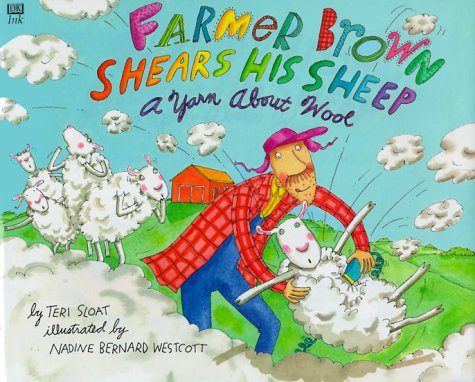
Farmer Brown Shears his Sheep: a Yarn about Wool, by Teri Sloat, with illustrations by Nadine Bernard Westcott.

This adorable book is the third in a series about Farmer Brown, and it seems to be sadly out of print. After being shorn and left with only fuzz in the chilly Spring air, the sheep follow Farmer Brown around as he takes the wool to be dyed and spun into yarn. The perplexed sheep end up tangled in the yarn before Farmer Brown realizes what’s going on, but all ends happily once he knits each of them a colorful, comfy cardigan to wear. The bouncy rhythm and easy rhyme, plus the giggle-inducing pictures, make this a winning picture book, so I’m sad to see that it’s only available through third-party sellers on Amazon, and not at all at Powell’s. Get it second-hand, or check it out from your local library to share.

Book Review: Sweater Quest

I’ve been waiting for this book to come out since Martini was interviewed on Cast-On last year. I enjoyed her first memoir – actually, since it was about her experience with Postpartum Depression, maybe enjoyed isn’t the word I want to use.  But it was a great book.  So, I had high hopes for this second outing, and I was not disappointed.

I pre-ordered through Amazon and received my copy today. Since Lil Miss was napping and K was watching something that appeared to be a movie involving World War II, I headed out to the Sky Chair on the deck.  And there I stayed until I finished the book.

Here’s my review as it appears on Amazon, GoodReads, and LibraryThing:

It seems like such a silly idea: A memoir about knitting a sweater? But like Stephanie Pearl-McPhee (who makes an appearance), Martini isn’t really writing about knitting. She’s writing about knitters. Mostly, just one knitter.

Over the course a year, Martini sets out to complete a sweater known as “Mary Tudor”. As she tackles the challenges of acquiring an out-of-print pattern and substituting for out-of-production yarns (no small feat for a project in which color is key) as well as stranded colorwork and steeking, she gathers together details about the designer, Alice Starmore. She explores why knitters are so attracted to Starmore’s famously difficult-to-obtain and difficult-to-knit patterns, and how far they can stray from the designer’s vision yet still remain faithful to the project.

Martini travels to Rhinebeck, Nashville, and Toronto to interview bloggers well-known to knitters around the world. The history of Tudor Roses and the Alice Starmore brand intertwine with the history of knitting in the Shetland Isles and North America and the life one particular American woman in the early twenty-first century. Witty and self-deprecating, Martini doesn’t hesitate to share her liberal leanings or drop the occasional curse word. Her writing style is clean and sharp, a pleasure to read. She’s clearly aware of the absurdity of her “quest”, which just makes it all the more enjoyable.

I gave it 5 stars out of 5.