Book Review: Invisible Inkling by Emily Jenkins

Invisible InklingInvisible Inkling by Emily Jenkins

My rating: 5 of 5 stars

I imagine airplanes that argue with their pilots, drinks that change the color of your skin, and aliens who study human beings in science labs — all when I’m supposed to be doing something else.

Fourth-grader Hank Wolowitz is the first person to admit he has an “overbusy” imagination. But he knows he isn’t imagining the small, furry, invisible animal that was hiding under the sink in his parents’ Brooklyn ice-cream shop. The animal that he rescued from the neighbor’s dog. The animal that calls itself Inkling, says that it’s an endangered bandapat, and that it is not leaving until it repays the debt it now owes him. Hank can certainly use a friend; his best friend just moved to Iowa City over the summer. As if that weren’t bad enough, Hank quickly becomes the fourth-grade bully’s favorite target. Since Hank can’t get any help from the ambivalent lunchroom aides, his oblivious teacher, or his pacifist parents, Inkling is determined to solve the problem for him.

With a quick pace and an engaging narrator, this sweetly funny book is sure to please. Aside from the invisible bandapat, the story feels utterly realistic without being grim. Kids will find it easy to identify with Hank, who just wants to get through a day without having half his lunch stolen. Harry Bliss’ signature illustrations are the perfect complement to Jenkins’ quirky story. Recommend especially to readers outgrowing Roscoe Riley and Clementine.

Book Source: e-ARC via NetGalley, by request

View all my reviews

Book Review: Delirium by Lauren Oliver

Delirium (Delirium, #1)Delirium by Lauren Oliver

My Rating: 3 of 5 stars

Book Source: e-ARC via NetGalley, by request
The deadliest of all deadly things: It kills you both when you have it, and when you don’t.

Ninety-five days. That’s how long it will be before Lena turns 18 and has “the procedure”, a sort of brain surgery to prevent Amor deliria nervosa, the disease of love. After that, she will complete her education, be married to a suitable young man, and have however many children the evaluators deem appropriate. In the first few chapters, the reader gets acquainted with Lena and learns that she has plenty of reasons to fear ever falling in love. As in any good dystopian scenario, though, all is not well in this new loveless America, and Lena begins to uncover the truth behind the many lies she has been told.

The idea of love as an eradicable disease, and that its elimination would create a perfectly content society, is an interesting one, but it never really becomes clear how the destruction of the “sickness” became the U.S. government’s number-one priority. The book lacks the solid world-building really needed to support the reader’s suspension of disbelief, but sympathetic characters, suspenseful action scenes, the promise of secrets revealed, and the specter of doomed romance all combine to keep the reader turning pages to the end.

There is a little echo of Atwood’s The Handmaid’s Tale in the way the government has taken control of so many facets of people’s lives, especially their relationships, and there is a big echo of Buffy the Vampire Slayer in the way a metaphor becomes literal. In Lena’s world, love really does make you crazy. It really might kill you. And it really can save you in the end.

View all my reviews

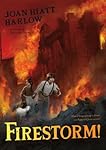
Book Review: Firestorm! by Joan Hiatt Harlow

Firestorm!Firestorm! by Joan Hiatt Harlow

My rating: 3 of 5 stars

Book Source: Checked out from the public library

The ground in Chicago was always damp, so the city officials had decided to raise the level of the streets. Old buildings and foundations, which couldn’t be lifted, were empty. It wasn’t long before a man named Roger Plant and his wife claimed ownership of the deserted foundations along Wells Street and rented out the vacant cellar rooms to all sorts of criminals and tramps.

When 12-year-old Poppy wakes up coughing in the early hours of September 30th, 1871, all she sees before her is a grim future in Chicago’s “underworld”. Abandoned by her mother years before, she was taken in by Ma Brennan and her “School for Girls” to learn the fine art of picking pockets. But later that day, a chance meeting with the son of a jeweler marks the beginning of some major changes for Poppy.

Justin Butterworth is sick of living in the shadow of his older brother, Charlie, and desperate to prove himself responsible enough to do more in the family jewelry shop than just sweep the floors. Poppy isn’t like any girl he’s ever known, but when she runs into him (literally), it’s the start of a friendship.

Over the next week, both Poppy and Justin deal with challenges, but all the day-to-day matters fade in importance when fire runs through the city.

In alternating chapters, Harlow describes events from Poppy’s and Justin’s point of view. Usually, these accounts overlap, so when the reader reaches the end of one chapter, the beginning of the next chapter jumps back a few hours. This drags out the narrative a bit, especially in the early chapters, when the very different lives of the two characters are revealed; impatient readers may wonder just when the big fire is actually going to start. The drama and suspense of the interwoven stories pulls the reader along, though. A comforting epilogue lets the reader know how things turn out, and an Afterword by the author notes which of the characters are entirely fictional and which are based on historical figures. Recommend to third- to sixth-grade historical fiction fans.

View all my reviews

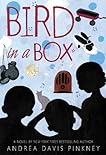
Book Review: Bird in a Box by Andrea Davis Pinkney

Bird in a BoxBird in a Box by Andrea Davis Pinkney

My rating: 4 of 5 stars

Book Source: e-ARC via NetGalley, by request
The only thing folks are talking about is that this will be the fight to end all fights. And nobody seems to care about the tough times we’re in, either. People are putting down their last little bit of money, betting on Joe Louis.

In this moving historical novel, Pinkney introduces three young African-Americans in Depression-era Elmira, New York. Hibernia is a 12-year-old preacher’s daughter with dreams of becoming a famous jazz singer. Otis is trying to keep his memories of his father and mother alive by retelling the riddles his father loved to tell. Willie had dreams of becoming a champion boxer, until his abusive father put an end to them.

The novel opens as Louis is about to take on Braddock in a much-hyped fight for the Heavyweight World Champion title, then jumps back a year to recount how the three main characters’ lives have intertwined. Pinkney presents a coherent, flowing narrative while rotating perspective between three distinct voices. She seamlessly blends real historical figures and events with her fictional characters to create vibrantly realistic scenes. An author’s note provides biographical information about Joe Louis and the members of the author’s own family that she used as models for some characters.

With lively, engaging characters and a skillful evocation of time and place, this is an excellent choice for young readers, even those who might not normally be drawn to historical fiction. Consider introducing de la Peña and Nelson’s A Nation’s Hope: The Story of Boxing Legend Joe Louis to readers interesting in learning more about Louis himself.

View all my reviews

Book Review: Science Fair Season by Judy Dutton

Science Fair Season: Twelve Kids, a Robot Named Scorch . . . and What It Takes to Win

Science Fair Season: Twelve Kids, a Robot Named Scorch . . . and What It Takes to Win by Judy Dutton

My rating: 4 of 5 stars

Book Source: E-ARC via NetGalley, by reviewer’s request


Fact: I was never part of a Science Fair. It’s one of those things that I’m a little sad to have missed out on. But Dutton offers a chance to live vicariously through some kids who are really part of the Science Fair scene. Twelve students are profiled in individual chapters, which alternate between a student (as of the book’s writing) headed for the 2009 Intel International Science Fair after winning a qualifying local competition and a participant in a previous year who has become Science Fair Legend. Their projects are not simple baking soda volcanoes or skin cells under microscopes; these are kids who have done things like build a nuclear reactor or create a home heating system out of salvaged materials.

Dutton takes the reader deep into the world of the Science Fair, interviewing not only the students, but also parents, teachers, and mentors. The young scientists reveal themselves to be teenagers much like their less scientifically-inclined peers, just kids with some quirky interests and an uncommon drive to explore. If you think you know what a Science Fair – or a Science Fair entrant – is all about, this book may surprise you. An entertaining and informative peek into the lives of the next generation of scientific discovery for teens and adults alike.

View all my reviews

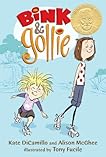
Book Review: Bink & Gollie

Bink and GollieBink and Gollie by Kate DiCamillo

My rating: 4 of 5 stars
Book Source: Checked out from the library

Bink and Gollie are the best of friends. They love roller-skating (on quad skates, not in-line blades) and pancakes (Gollie cooks them, Bink eats them). They don’t always agree on everything, but they find ways to compromise. DiCamillo and McGhee tell these three short stories completely in dialogue between Bink and Gollie. The actions and scene-setting are left to illustrator Tony Fucile, whose cartoon panels are utterly charming. The scenery around the characters is drawn in black-and-white, while Bink, Gollie, and the occasional guest adult, fish, or outrageous sock shine in full color. So much of the story is told through the illustrations, in fact, that it would be possible for a non-reader to understand and enjoy it without the text, but missing the playful banter would be a shame. There is some advanced vocabulary (“‘The problem with Bink,’ said Gollie, ‘is her unwillingness to compromise'”) for beginning chapter-book readers; this would be a good choice to read aloud to younger readers, although a motivated young reader might take the opportunity to learn the words in context.

The girls have been compared to Frog & Toad and George & Martha. I see a little bit of Ramona and Beezus in them. Gollie is the responsible one, sometimes exasperated with little Bink, but steadfastly loyal to her all the same. I sincerely hope that this is only the first volume of their adventures.

View all my reviews

Book Review – Alvin Ho: Allergic to Birthday Parties, Science Projects, And Other Man-Made Catastrophes

Alvin HoAlvin Ho by LeUyen Pham

Book Source: Checked out from the library

My rating: 3 of 5 stars

The third installment of this series about worry-ridden second grader Alvin Ho runs along the same lines as the previous two. Alvin is still carting his PDK (Personal Disaster Kit) everywhere he goes, still making lists, and still trying to navigate the tricky spots where the world of girls and the world of boys intersect, especially since his best friend happens to be a girl. There are some very touching moments when Alvin gets a little bit of guidance from his father, while Alvin’s struggles to communicate with his mother and his bickering with his older brother and younger sister keep the family life from getting too sweet. Alvin’s relationship with his dad is a stand-out feature of this series; as in most kid books, the parents are largely relegated to the background while the children take center stage, but Alvin’s parents (especially his dad) are clearly level-headed, responsible, loving parents, and Alvin’s respect for them shines through.

LeUyen Pham’s appealing pen-and-ink illustrations add just the right visual element to Alvin’s ridiculous predicaments. Any of the books in this series can stand alone and would be a good choice for fans of Roscoe Riley looking a little longer (though still quick-paced) read.

View all my reviews

Book Review: Almost Perfect

I took a little while after reading this one to put up a review. It’s this year’s Stonewall Award winner in the Children and Young Adult category, and I wanted to like it more than I did. Don’t you hate when that happens?

Almost PerfectAlmost Perfect by Brian Katcher

My rating: 2 of 5 stars
Book Source: Checked out from the library

I knew I shouldn’t stare, but I couldn’t look away. Girls this strange didn’t exist in Boyer. They lived in Columbia or Kansas City or places like that.

High school senior Logan Witherspoon has known all of his classmates since kindergarten. In a town the size of Boyer, MO, everyone knows everyone. So, it’s a surprise when a new girl, Sage, joins his biology class. With her outgoing nature and flashy clothes, she seems like the polar opposite of Logan’s ex-girlfriend, the girl he dated for three years and thought he might one day marry. Sage is attractive and intriguing, but Logan knows she’s hiding something about her past. He never thinks to suspect that her secret is that she was born in a male body.

The first-person narration gives the reader Sage’s story filtered through Logan’s experience, making this more a story about Logan’s meandering journey out of total transphobia than about Sage herself. Katcher creates a believably confused and sympathetic Logan, so it’s unfortunate that Sage feels like an amalgamation rather than a fully-fledged character in her own right, as if events from different people’s lives were thrown together and expected to become a coherent backstory.

Katcher explores the meanings and boundaries of friendship, love, and loyalty, issues that any teenager struggles with. Logan’s interactions with his sister, mother, and friends contrast against Sage’s description of her relationships with her parents and sister, just as the relationship Logan had with his ex-girlfriend forms a stark contrast to his developing relationship with Sage. Logan’s story will prompt teen readers (and maybe some adults, too) to think about how they would act in his situation. And that can only be a good thing.

View all my reviews

Book Review: This Isn’t What It Looks Like

This Isn't What It Looks LikeThis Isn’t What It Looks Like by Pseudonymous Bosch

My rating: 4 of 5 stars

Book Source: Checked out from the library

The fourth book in the series that began with The Name of This Book is Secret picks up where the third volume left off. In the early chapters, narrator Bosch splits attention between two stories: one is about a girl who wakes up in what appears to be a medieval European village unable to remember who she is, where she is, how she got there, or why she happens to be invisible; the other is about Max-Ernest, who is desperately trying to awaken his friend Cass, who has been in a strange sort of coma since taking a dose of time-travel chocolate. The reader can quickly figure out how these two stories mesh (you’ve probably put it together just reading this review), and it’s a relief when the two stories converge into one.

There is a lot of silliness here, in the style of the writing as well as the plot. Cass and Max-Ernest remain the center ground for the reader amid the swirl of outrageous situations and goofy narration. Bosch reads much like Lemony Snicket, explaining things in footnotes and hinting at secrets never quite revealed. Several of these footnotes refer the reader back to previous installments in the series; jumping into the series with this book is definitely not recommended. A cliff-hanger ending (and the fact that our heroes still haven’t uncovered The Secret) leaves readers anxiously anticipating the final volume, slated for publication in October 2011.

View all my reviews

Book Review: Roscoe Riley Rules: Never Glue Your Friends to Chairs

Roscoe Riley Rules #1: Never Glue Your Friends to Chairs (Roscoe Riley Rules (Hardback))Roscoe Riley Rules #1: Never Glue Your Friends to Chairs (Roscoe Riley Rules by Katherine Alice Applegate

My rating: 4 of 5 stars

Book Source: Checked out from my library.

Kids have to follow so many rules!
Sometimes my brain forgets to remember them all.
It’s not like I
try to find ways to get into trouble. It’s just that trouble has a way of finding me.

In this first book in a series, Roscoe Riley, a first-grader with “high spirits”, welcomes us to his Official Time-Out Corner to hear the story of exactly what put him there this time. He was really just trying to help his teacher. Who knew it was a bad idea to glue things to people with the Super-Mega-Gonzo Glue?

This is a quick, breezy read, with one- and two-sentence paragraphs and short chapters interspersed with Brian Biggs’ cartoony black-and-white illustrations. Well-meaning but short-sighted Roscoe will be a familiar character to adults and kids, and his droll delivery will raise more than a few giggles. I can’t help but think of Roscoe Riley as similar to Junie B. Jones, but with more boy-appeal. Perfect for young readers just getting into chapter books.

View all my reviews